Tuesday, October 29, 2013

SAS Solar Launch


On Saturday, SAS hosted the Solar Launch of its 3,356 panel photo-voltaic system! High school and Middle School GIN collaborated with each other for over a month and the result: success. We had Singaporean members of parliament attend, as well as the new American ambassador and our own superintendent at the venue. Elementary school kids dressed up as suns to greet guests, middle school students created videos, held tours all day with high school club members' help, and teachers, staff, parents were present too.  I love events like these because they really gather and demonstrate community support, awareness, and action; and it's one of the reasons I'm using SAS as a case study in my Capstone report. 

Here are some videos featured during the Solar Launch: 


Next week, I'll be going to pristine Tioman Island with my AP Environmental Science class and then Beijing for our annual GIN conference! I've heard that the section of Pulau Tioman we will be staying in is almost untouched by humans and previous years' classes have seen baby sharks; I can't wait to experience living in the real tropical rain forest! I always wonder what Singapore would have looked like 200 years ago and this is my chance to go see it live. The GIN conference is bound to be charged with energy. SAS is taking 20 students, each in a different "Global Action Network Group (GANG)." I'll be a part of the biodiversity and ecosystems group and I hope to be able to take my knowledge from Tioman to Beijing. 


Thursday, October 17, 2013

Climate change strikes again

Pacific islanders are facing difficulties with rising sea levels already. 

BBC just published an article (found here) about a man seeking "climate change asylum" in New Zealand as his home, the Kiribati atolls are severely affected by rising sea levels. Earlier this year, he was denied asylum with the claim that his life was not threatened by conditions in Kiribati. But he's still fighting; decisions will be released in the next couple of weeks. 

While government officials in Kiribati are doing their best to buy land from Fiji and mitigate possible disasters in the near future, it is evident that climate change is causing major problems worldwide, for everyone. 

I imagine that in the next couple of years, cases like these will become a lot more common. What will governments decide to do? Will there be a universal code of acceptance (hopefully not shunning) of those who have lost their homes due to all of our irresponsible actions? 

There have been attempts to raise awareness and persuade the world to empathize with climate change refugees. In 2010, filmmaker Michael Nash produced a documentary named "Climate Refugees," hoping to bring attention to the perilous effects of climate change on people. He asks, in the trailer, "How long is man going to survive on this beautiful planet?" The question goes seamlessly well with what we're discussing in AP Environmental Science right now: the ability of the rapidly changing planet and environment to accommodate more people.


I will be watching this documentary this weekend and I encourage you to as well. I hope to organize a screening of "Climate Refugees" at school soon. 

For me, such incidents really bring out the importance of individual understanding and care. Climate change is a global phenomenon, concerning all 7 billion people; Nash's documentary is what we need to connect with each other. 

Because until the carbon dioxide levels do drop to 350 parts per million, human compassion is all we have to help each other. 


Sunday, September 29, 2013

Climate change is real

You'd think that by 2013, 99.9% of the world would agree that humans have disrupted the balance of the hydrologic, sulfur, nitrogen, phosphorus and carbon cycle. There's too much evidence in our every day lives to ignore it. 

We're not quite there yet. As of Friday, September 27th,  95% of the scientific world agrees that climate change exists. 


On Friday, the Intergovernmental Panel on Climate Change (IPCC) confirmed, with scientific investigations, research, and data to back it up (especially for all the nonbelievers), that "half of the observed increase in global average surface temperatures since the 1950s" is human caused. 

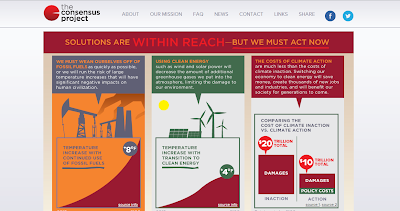
Compare the 95% consensus to the general mindset in 2001; 66% to 95% is a big jump. Several organizations, such as 350.org and The Consensus Project attempt to bring awareness to the masses with simple graphics and campaigns. Their one goal is to educate the public about the degradation of the planet and possible solutions. 

Their reasoning is clear. When the public understands climate change, the causes behind devastating hurricanes and floods stand out. Air pollution and heat waves will be seen as effects of anthropogenic activity. People will begin to realize the impact (financial, environmental, and social) of thermal expansion on ice, glaciers and ice caps melting, and sea levels rising. They'll start reflecting on humanity's actions, think of innovative solutions, and mold the rigid economic systems that restrict much needed actions. 

The 399 parts per million of carbon dioxide in the atmosphere isn't going to disappear over night. Hundreds of factors come into play when making decisions that will mitigate the adverse consequences of climate change. Reaching the truth is definitely one of them. 

Wednesday, September 11, 2013

Environmental updates!

School has begun again! With the homework and tests come exciting environmental initiatives. There are so many ideas and so much energy among the green community - the perfect combination to act! 

Our school installed 3356 solar panels over the summer, with the help of the Solar Energy Research Institute of Singapore (SERIS) and a local solar energy company Sunseap! They account for 30% of the school's energy consumption and can produce 1 MW of power on the sunniest, clearest days. The Middle School Global Issues Network (GIN) club will be working with the High School SAVE and GIN club to present the school's new source of renewable energy to the whole community. It's a great example of direct steps taken by the school to become a greener campus! 

I'm taking a class called Senior Capstone this year. It's an opportunity to independently research and study a subject of my choice. I chose the environment (no surprise!); I'm using Singapore American School (SAS - my school) as a case study, as well as some Canadian schools, and creating a green guidebook for already established schools. My focus is not on the physical campus but the additional efforts a school can take to become a more environmentally friendly community. I'm splitting up initiatives in terms of student driven, technology, and waste management. It's a work in progress but I love being able to connect it to the current AP Environmental Science (APES) class I'm taking. I'm learning of plenty of real life examples to apply my growing understanding of the environment. 

In the past few weeks, I've gone to a couple of talks on biodiversity and plastic. The Singapore Land Transport Authority is planning to build an MRT through the primary forests of Macritchie reservoir. Last Thursday, as a part of a biodiversity talk, botanist Joseph Lai went through 200 slides of pictures (taken by him) of the unique species that live in Singapore's primary forests. He knew all of them by heart and it was incredible to see the variety of life that exists on this once tropical forested island. Visit http://www.chope4nature.org/ to join the protest against the cutting down of this rich primary forest! 

Two weeks ago, I also went to a Plastic Symposium held by the National University of Singapore's SAVE (Students Against the Violation of the Environment) group. They invited several guest speakers - an environmental entrepreneur engaged on the business side of things, a government representative from the National Environment Agency, and an NUS professor who spoke about the impact of plastic on marine life. It was so interesting to see so many different schools there to understand the state of plastic waste in Singapore, despite the fact that it was a Saturday afternoon. I found it especially interesting that plastic, whether recycled or not, is always incinerated in Singapore. 

The year's off to a great start and I'm proud to say I'm a part of it! 


Saturday, July 27, 2013

A few universities' commitment to the environment

UC Berkeley's Road to Zero Waste commitment


Some interesting tidbits from UC Davis' Zero Energy village


The two UCs (University of California) I visited, as you can see, are dedicated to helping the environment and implementing a variety of advertising/awareness techniques that allow everyone to understand their drive to reduce their carbon footprint. 

I also got a chance to talk to some professors at UC Davis and U of Michigan, Ann Arbor. Both are involved in research regarding the efficiency of water purification, and UC Davis has a project that aims to seal up cracks in whole houses using a nitrogen compressor, within one hour. The lab has actually sealed two real houses so far and hope to expand the project to do larger buildings in the future. I think this project is unique in the sense that it offers a very practical solution to energy efficiency - airtight homes mean that less energy can be spent on heating up a home because the warm air is retained. 

A picture of the lab: 

Stanford University's Y2E2 buildings is a tall and strong symbol of the university's commitment to sustainability. New buildings being  constructed are using Y2E2 as the standard, according to our tour guide. It uses 50% of the energy to run and only 10% of the potable water required for fixtures, in comparison to a typical building of its size, according to Stanford News. The energy efficient building is another asset to Stanford's environmentally conscious profile. 

Y2E2

To see more on Y2E2 and picture credit: http://news.stanford.edu/news/2008/march5/y2e2-sustain-030508.html


It's assuring to see so many universities commit to the grueling issues of today's world! Tertiary education is the stage where the somewhat insulated secondary school meets the reality of life and I think the fact that colleges are aiming to bridge the gap is powerful. Students are given the opportunities to glimpse into the solutions that we can implement in the future. 

Think green!


Wednesday, June 26, 2013

Environmental atrophy

Examples of products that waste resources and destroy the planet that I am seeing on a day to day basis here: 


Lawns. Almost all suburban (on a global scale) homes have front and back lawns. These take thousands of gallons of water to maintain, a clear waste of potable water. Even John Green agrees with me! He pictures a world with vegetable gardens instead of yards and imagines the prosperity that would come out of this. 


Krispy Kreme's styrofoam cups! Although you can't tell from the picture, this cup is made of styrofoam. Use paper cups Krispy Kreme! I urge consumers to not drink coffee and/or water if possible at Krispy Kreme - you're supporting sytrofoam cups! 


Tuesday, June 25, 2013

Climate change alerts


Floods are devastating the Indian state of Uttarkhand. This is a clear example of climate change. Unstable grounds, mass tourism, and torrential rains during the monsoon season are highlighted as the primary reasons for such a natural disaster. 

I keep thinking back on my time as a facilitator at the GIN conference for the Natural Disaster Prevention and Mitigation team when I read news reports claiming that the Indian government did not warn the local people about the possibility of floods. 

While June to September is usually the monsoon season in India, the heavy rain coupled with frequent landslides has culminated in losses of life and disaster. 

Prayers going out to Uttarkhand. 


The ultimate conclusion: We need to fight climate change.