Showing posts with label APES. Show all posts

Wednesday, May 28, 2014

Saying goodbye to APES

Keystone XL Pipeline update (May 18th): Grassroots movements are rallying together to disapprove of the proposed Keystone pipeline. The group Bold Nebraska, established by Jane Kleeb, represents farmers opposed to the pipeline and TransCanada. It's exciting to see more citizens becoming vocal about their opinions, as they recognize the adverse effects that the pipeline will bring. 

APES: Yesterday, I had my last AP Environmental Science class of the year, on the last day of high school. It was emotional, because the class has guaranteed more than an education for me. The experiences that APES has provided, introducing me to my best friends and taking me to remote tropical islands, are incredible. I'm going to miss the class and Ms. Began so much. 

Our last assignment included writing a letter to a person of power, regarding an environmental issue we cared about. I wrote to the president of the college I'll be attending - Harvey Mudd - about divesting from fossil fuels. The letters are getting mailed today; I hope I receive a response! 

Here is an excerpt of my reflection of APES: 


Taking AP Environmental Science has been such an enlightening experience. It’s one of the only classes that focuses on issues beyond the individual, applicable to real life. Our generation has so many environmental challenges to tackle, before climate change drowns San Francisco and poor waste management leaves half the world sick and destitute. While it’s easy to be discouraged by the intense work that lies ahead, this class has taught us that there are solutions. We have the opportunity to fix problems and we need to take it.

“We shall never achieve harmony with the land, anymore than we shall achieve absolute justice or liberty for people. In these higher aspirations the important thing is not to achieve but to strive.” Aldo Leopold


Thursday, January 30, 2014

Gold mining in Indonesia

In AP Environmental Science, we keep track of current environmental news. Here's a snippet from our non-renewable resources unit - my reflection on a New York Times article on gold mining in Indonesia.

What do we want? Fancy gold jewelry or brain damage, kidney malfunctioning, and dysfunctional neurological development for those that provide the metals? 

A recent investigation of Indonesia’s gold mining industry shows us an alarming trend: one hundred grams of mercury are incorporated into the purified gold amalgam during the processing stage. 

Some environmental activists believe that the mercury is not being legally imported, but smuggled into Indonesia for small-scale miners, under the radar. It seems preposterous that the miners would be willing to put themselves at risk but in the lower income level regions of Indonesia’s mining industry, lack of education and high gold prices are to blame. Miners burn the mercury after purifying the gold with it, in turn releasing the heavy metal into the atmosphere and any liquid excesses into nearby water bodies. 

But the damage isn’t limited to wildlife. Children in the area been found to have dysfunctional motor skills, while parents that operate the gold purifying businesses have internal mercury levels as high has 25 parts per million, as opposed to the World Health Organization’s healthy standard of one ppm. I believe that when environmental degradation and health hazards coincide, it’s a sign that the manufacturing process and world of consumerism must change. 

Buyers’ demand for precious metals, prices, and purity often obscure the adverse environmental and health impacts behind the curtain of air conditioned showrooms and thief proof cases. Educational programs on both sides of the spectrum – manufacturing and consuming – need to be implemented for healthier mining. 


Tuesday, November 12, 2013

A trip to Tioman, Malaysia

I just got back from Tioman and Beijing. Fall break was definitely well spent. 

Tioman, Malaysia

I loved every bit of our AP Environmental Science trip to Tioman. The coral reef surveys, beach profile, primary and secondary forest transects reaffirmed my love for environmental science. I didn't know I could enjoy fieldwork and labs so much. 
Harvested sections of a
palm oil plantation in Malaysia

As we drove through the Malaysian country side, we saw that the main crop was Oil Palm. Large tracts of land that were once South East Asian rainforests are now made up of thousands of rows of the Oil Palm. It's sad to see how much biodiversity is lost when this happens. 

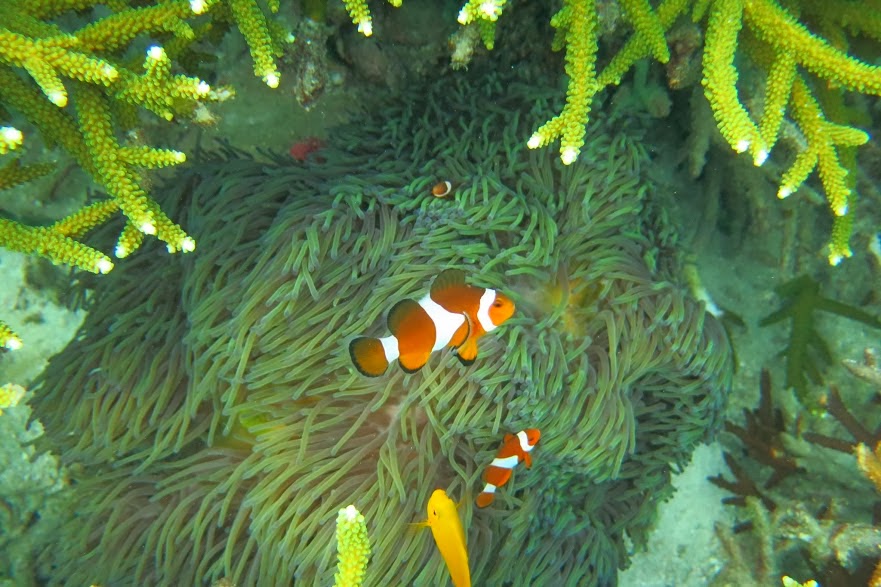
We spent the first day comparing pristine coral reefs, home to hundreds of bright fish, and damaged coral reefs, a result of continuous ship anchoring near resorts. We noted readings of air temperature, humidity, light intensity, water salinity, turbidity, pH, conductivity, total dissolved solids, and more,which we'll use to estimate the water quality index of the ocean water. 
Clownfish at the pristine coral reef site,
Photo by APES classmate Tamara Dibb


Shrimp found in the
fresh water stream
On the second day, as a member of the conservation scientist team, I debated about the pros and cons of setting up Oil Palm plantations on Tioman, much of which is a government protected nature reserve. Later on in the day, we took a belt transect of the rocky shore and random sampling of the percent cover of pedina algae, sea cucumber density, and sponge local frequency. Wading through the water, touching sedentary marine animals was enthralling, especially in such sunny, sticky weather.

Finally, we surveyed the primary and secondary rainforests of Tioman. I didn't know so many shades of green could exist. Under the thick canopy, the refreshing cool air made up for the stiffling humidity and capturing macroinvertebrates in the fresh water stream was rewarding after hiking uphill for several hours. We took soil and leaf litter samples, canopy cover estimates, and tree maturity recordings. 


The stream in the secondary forest,
Photo by APES classmate Tamara Dibb 
I loved bonding with my team as we sorted the shrimp from the fresh water river sample, identified rocks under which scorpions hide at night, using UV light, and eating sunflower seeds on the boat rides. It's so exciting to be able to hug trees that have been standing for over several hundred years. I felt like I was on the set of Jurassic Park. I'm really glad that I have had this opportunity to visit almost untouched tropical rainforest region! I loved it so much. 

A big thank you to my teacher and the TAs for organizing it and helping me rediscover my love for the environment. 

Next up: I'll be writing about my experience at the November 7th to 10th Global Issues Network conference in Beijing. 


Good vibes and prayers going out to the Philippines after the horrific typhoon - more evidence that we need to act on protecting the environment soon. 


Wednesday, September 11, 2013

Environmental updates!

School has begun again! With the homework and tests come exciting environmental initiatives. There are so many ideas and so much energy among the green community - the perfect combination to act! 

Our school installed 3356 solar panels over the summer, with the help of the Solar Energy Research Institute of Singapore (SERIS) and a local solar energy company Sunseap! They account for 30% of the school's energy consumption and can produce 1 MW of power on the sunniest, clearest days. The Middle School Global Issues Network (GIN) club will be working with the High School SAVE and GIN club to present the school's new source of renewable energy to the whole community. It's a great example of direct steps taken by the school to become a greener campus! 

I'm taking a class called Senior Capstone this year. It's an opportunity to independently research and study a subject of my choice. I chose the environment (no surprise!); I'm using Singapore American School (SAS - my school) as a case study, as well as some Canadian schools, and creating a green guidebook for already established schools. My focus is not on the physical campus but the additional efforts a school can take to become a more environmentally friendly community. I'm splitting up initiatives in terms of student driven, technology, and waste management. It's a work in progress but I love being able to connect it to the current AP Environmental Science (APES) class I'm taking. I'm learning of plenty of real life examples to apply my growing understanding of the environment. 

In the past few weeks, I've gone to a couple of talks on biodiversity and plastic. The Singapore Land Transport Authority is planning to build an MRT through the primary forests of Macritchie reservoir. Last Thursday, as a part of a biodiversity talk, botanist Joseph Lai went through 200 slides of pictures (taken by him) of the unique species that live in Singapore's primary forests. He knew all of them by heart and it was incredible to see the variety of life that exists on this once tropical forested island. Visit http://www.chope4nature.org/ to join the protest against the cutting down of this rich primary forest! 

Two weeks ago, I also went to a Plastic Symposium held by the National University of Singapore's SAVE (Students Against the Violation of the Environment) group. They invited several guest speakers - an environmental entrepreneur engaged on the business side of things, a government representative from the National Environment Agency, and an NUS professor who spoke about the impact of plastic on marine life. It was so interesting to see so many different schools there to understand the state of plastic waste in Singapore, despite the fact that it was a Saturday afternoon. I found it especially interesting that plastic, whether recycled or not, is always incinerated in Singapore. 

The year's off to a great start and I'm proud to say I'm a part of it!