Tuesday, March 4, 2014

Apple acknowledges climate change

Sorry about missing a February post! School has been busy - Global Issues Network is hosting a local conference for students islandwide - GINSING2014 - to brainstorm solutions to issues prevalent in Singapore on March 16th. We're also trying to integrate sustainable uniforms, made by Waste 2 Wear, into the school's dress code policy to promote closing the consumer waste cycle. A number of fundraisers, like County Fair at school, have been helping us raise money for our causes. It's been a busy few weeks! I hope the outcomes turn out positively as well. 


This recent article by the Guardian may herald a new wave of corporate sustainability. Apple has declared that it will continue to invest in sustainable energy resources, attempting to "curb its environmental impact" while fighting "the use of minerals mined in the DRC that can fund war and human rights abuses." When multinational corporations start making it clear that they support protecting the planet, I take it as a good sign. Hopefully this will encourage others to take a stand against rising carbon dioxide emissions. Let's hope that Apple sticks to their promises.

Friday, January 31, 2014

The Pipeline

At the convergence of politics, economics, and environmentalism lies the issue of the Keystone XL oil pipeline. The State Department contends that the project will have little impact on climate change but ignores the fragmentation of wildlife, land, and communities that will result. The environmental impact assessment is causing fissures within the Democratic Party and the entire country as environmental activists, organized labor, and job hungry Republican senators struggle against the implications of building the pipeline. 

Do we want dirtier oil, releasing 17% more carbon emissions, or several thousand jobs for Americans? There's a fine line that separates the socio-economic-environmental effects of the Keystone Pipeline. 

The comments on this CNN article are particularly interesting. 

All of us will be watching Obama in the next 90 days. Let's hope he makes the right decision.  


Thursday, January 30, 2014

Gold mining in Indonesia

In AP Environmental Science, we keep track of current environmental news. Here's a snippet from our non-renewable resources unit - my reflection on a New York Times article on gold mining in Indonesia.

What do we want? Fancy gold jewelry or brain damage, kidney malfunctioning, and dysfunctional neurological development for those that provide the metals? 

A recent investigation of Indonesia’s gold mining industry shows us an alarming trend: one hundred grams of mercury are incorporated into the purified gold amalgam during the processing stage. 

Some environmental activists believe that the mercury is not being legally imported, but smuggled into Indonesia for small-scale miners, under the radar. It seems preposterous that the miners would be willing to put themselves at risk but in the lower income level regions of Indonesia’s mining industry, lack of education and high gold prices are to blame. Miners burn the mercury after purifying the gold with it, in turn releasing the heavy metal into the atmosphere and any liquid excesses into nearby water bodies. 

But the damage isn’t limited to wildlife. Children in the area been found to have dysfunctional motor skills, while parents that operate the gold purifying businesses have internal mercury levels as high has 25 parts per million, as opposed to the World Health Organization’s healthy standard of one ppm. I believe that when environmental degradation and health hazards coincide, it’s a sign that the manufacturing process and world of consumerism must change. 

Buyers’ demand for precious metals, prices, and purity often obscure the adverse environmental and health impacts behind the curtain of air conditioned showrooms and thief proof cases. Educational programs on both sides of the spectrum – manufacturing and consuming – need to be implemented for healthier mining. 


Tuesday, December 31, 2013

2013

2013 has been a year of environmental ups and downs. Here are 12 events that sum up the year.

January: President Obama's Second Inaugural Speech states that Americans "will respond to the threat of climate change." NPR reviews suggested that just mentioning climate change in his speech resulted in the "biggest cheers from the crowd."

February: A number of surveys conducted by the National Opinion Research Center at the University of Chicago finds that the degradation of the environment isn't a priority for people worldwide. The US is no exception to this rule, where the economy is #1 and the environment is #6. This is where my AP Environmental Science textbook's definition of sustainability comes into play: finding the right balance between socio-economic and environmental issues. 

March: Fertilizer runoff and human disturbance is proving to be detrimental for aquatic life in more than 55% of the US's streams. These findings were the result of the EPA's first stream and river health survey. 

April: The UK's carbon tax system is declared a leading country in its tackling of carbon emissions. The nation follows the KPMG Green Tax Index based in Switzerland, attempting to encourage corporate and individual sustainability.  

May: Danish 9th grade students discover that WiFi routers inhibit garden cress sapling growth. Could our widespread cell phone use adversely affect larger trees? The neuroscience department at the Karolinska Institute in Sweden is interested in repeating the experiment. 

June: Buttercup the duck is fitted with a silicone prosthetic foot, thanks to the merging of technology and animal care. Visit his Facebook page

July: A published report featured on CNN suggests that over two million deaths are attributed to outdoor air pollution annually. Fine particulate matter including dust, soot, smoke, and liquid droplets lodge in lungs, causing cancer and respiratory diseases. In addition, over 470,000 people die due to anthropogenic ozone pollution. 

August: 228 dolphins are found dead along the East Coast of the US. Lesions in the mammals' lungs may be due to the morbillivirus. Heavy metals, pesticides, and hydrocarbons dumped into the water are suspected to have made the respiratory infections worse. The deaths of the dolphins is worrying. As keystone and indicator species, healthy dolphins demonstrate an ecosystem of high integrity. 

September: California passes a bill regulating the fracking industry. While environmental groups were unhappy with the new law, oil and gas companies are now required to obtain permits before drilling. 

October: The government shutdown causes problems for people and the planet. Work near toxic waste sites was halted by the EPA, for example, and law suits that tried to close down polluting cement kilns were temporarily put on hold. 

November: Typhoon Haiyan devastates the Philippines and many cite climate change as a cause of the natural disaster. The warming of the earth and ocean as well as the disruption of regular currents induces intense tropical storms. 

December: It's not usual for the breezy Bay Area air to drop to -3 degrees Celsius. Yet this year the region, along with several other cities nation wide, is experiencing a severe winter. Global climate weirding is definitely a problem that needs to be addressed.  


Happy 2014! Let's make this one our most sustainable yet. 


Monday, December 9, 2013

Senior Capstone - Quick Start Guide to a Green School

For my Senior Capstone Project, I created a Quick Start Guide to a Green School; access it here.


This Quick Start Guide to Green Schools aims to inspire, encourage, and teach schools how to become more conscious of their actions and environment. Empowering students, faculty, and staff – a grassroots effort – is crucial to protecting the environment. The guide aims to foster beneficial environmental plans, proceeded by action, among schools worldwide. There are many ways to achieve sustainability but the key is to build a plan for the long term.  This guide is only one means of beginning a green school. There are so many ideas, steps, stages to follow but there is no set formula. By the end, hopefully your school will be more cognizant of energy, water, transportation, and waste issues, determined to make a difference through curricular changes, facilities management, and community involvement – the holistic approach to sustainability that involves every section of the school.

Singapore American School is used as a case study as a comprehensive example of successful environmental action across curriculum, facilities, and community support.


Wednesday, November 27, 2013

November's events: Global Issues Network

November was filled with GIN events, planning, and action:

BeiGIN: Beijing Global Issues Network Conference

The theme of the conference:
Hope, Humanity, Opportunity
From November 8th to 10th, 24 delegates from SAS's GIN club attended a conference in Beijing. Each of us were placed in Global Action Network Groups (GANGs) to brainstorm solutions to problems prevalent in South East Asia. I was in the Biodiversity and Ecosystems Loss GANG. Collaborating with people from Vietnam, Myanmar, and Thailand was an eye-opening experience, as we had to think about how solutions would be implemented given specific circumstances in each of these countries.

After attending and facilitating a GANG in last year's GINSING conference, however, I definitely feel that BeiGIN could have been more effective. Many of the actions we discussed were already in place at SAS, including a week-long environmental science trip to study the integrity of an ecosystem (Tioman!), article publishing in school 
periodicals (Crossroads and the Singapore American), and cultivating an eco-garden on campus (I'm a part of SAVE's eco-garden committee and our plans are currently being evaluated by administration). 

On the Great Wall  
The workshops and speakers were more focused on humanitarian issues; I actually cried when we watched Girl Rising (and I never cry during movies). I found its dual messages of challenge and hope really encouraging. I'm so grateful for the education I've received. 

Bundled up in the 5 degree C air, climbing up the Great Wall, and hunting for restaurants at 10 pm, all of us GIN members and officers bonded over this trip. It was a great end to fall break. 


Middle School GIN Mentoring - Success! 

Every Tuesday, high school GIN members and officers, including me, help middle school students interested in global issues, in their own GIN club. And as a part of SAS GIN, Service Council, and Wish for Kids (club)'s Wish for Tabuelan fundraising initiative for families devastated by Typhoon Haiyan, Middle School GIN took up the opportunity to raise thousands of dollars in the form of a competition. They used a coin-point system to increase competition among the sections of each grade, using an ice-cream treat at the end as the main motivator (food always works). In 7 days, this Coin Craze for Cebu has raised about $12,200! That's a large contribution to the school wide fundraiser that has raised $59,036.77 to date. 


Speaker Series 

GIN wrapped up its speaker series for the semester with World Vision, a disaster relief agency dedicated to helping children, and Emma Freedman, a teen conservationist who started Jungle Heroes. We had a decent turnout for each talk and are glad that other students are taking interest in our GINitiatives. 

Emma Freedman's poster 
Happy Thanksgiving to everyone! Enjoy your days off and get some extra sleep. Consider going easy on the turkey; you owe the planet! 

Tuesday, November 12, 2013

A trip to Tioman, Malaysia

I just got back from Tioman and Beijing. Fall break was definitely well spent. 

Tioman, Malaysia

I loved every bit of our AP Environmental Science trip to Tioman. The coral reef surveys, beach profile, primary and secondary forest transects reaffirmed my love for environmental science. I didn't know I could enjoy fieldwork and labs so much. 
Harvested sections of a
palm oil plantation in Malaysia

As we drove through the Malaysian country side, we saw that the main crop was Oil Palm. Large tracts of land that were once South East Asian rainforests are now made up of thousands of rows of the Oil Palm. It's sad to see how much biodiversity is lost when this happens. 

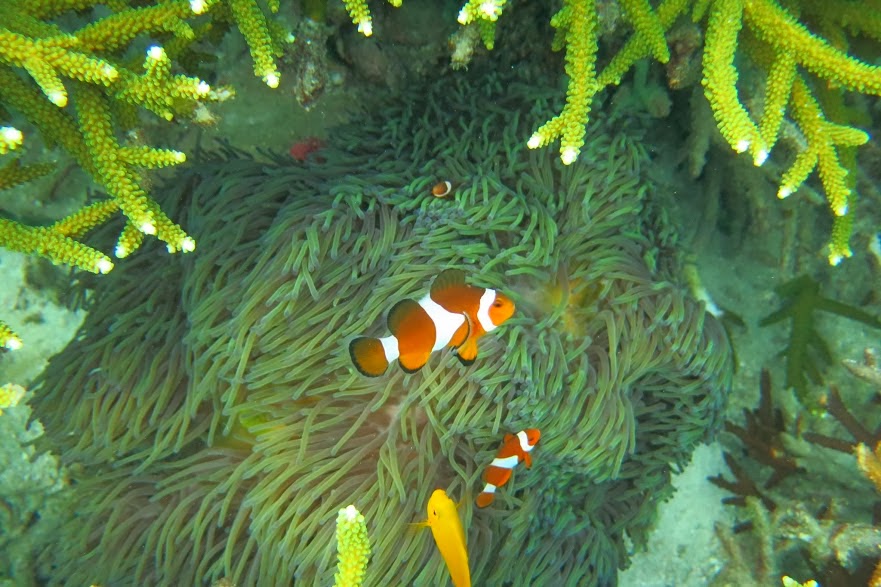
We spent the first day comparing pristine coral reefs, home to hundreds of bright fish, and damaged coral reefs, a result of continuous ship anchoring near resorts. We noted readings of air temperature, humidity, light intensity, water salinity, turbidity, pH, conductivity, total dissolved solids, and more,which we'll use to estimate the water quality index of the ocean water. 
Clownfish at the pristine coral reef site,
Photo by APES classmate Tamara Dibb


Shrimp found in the
fresh water stream
On the second day, as a member of the conservation scientist team, I debated about the pros and cons of setting up Oil Palm plantations on Tioman, much of which is a government protected nature reserve. Later on in the day, we took a belt transect of the rocky shore and random sampling of the percent cover of pedina algae, sea cucumber density, and sponge local frequency. Wading through the water, touching sedentary marine animals was enthralling, especially in such sunny, sticky weather.

Finally, we surveyed the primary and secondary rainforests of Tioman. I didn't know so many shades of green could exist. Under the thick canopy, the refreshing cool air made up for the stiffling humidity and capturing macroinvertebrates in the fresh water stream was rewarding after hiking uphill for several hours. We took soil and leaf litter samples, canopy cover estimates, and tree maturity recordings. 


The stream in the secondary forest,
Photo by APES classmate Tamara Dibb 
I loved bonding with my team as we sorted the shrimp from the fresh water river sample, identified rocks under which scorpions hide at night, using UV light, and eating sunflower seeds on the boat rides. It's so exciting to be able to hug trees that have been standing for over several hundred years. I felt like I was on the set of Jurassic Park. I'm really glad that I have had this opportunity to visit almost untouched tropical rainforest region! I loved it so much. 

A big thank you to my teacher and the TAs for organizing it and helping me rediscover my love for the environment. 

Next up: I'll be writing about my experience at the November 7th to 10th Global Issues Network conference in Beijing. 


Good vibes and prayers going out to the Philippines after the horrific typhoon - more evidence that we need to act on protecting the environment soon.