Wednesday, May 28, 2014

Saying goodbye to APES

Keystone XL Pipeline update (May 18th): Grassroots movements are rallying together to disapprove of the proposed Keystone pipeline. The group Bold Nebraska, established by Jane Kleeb, represents farmers opposed to the pipeline and TransCanada. It's exciting to see more citizens becoming vocal about their opinions, as they recognize the adverse effects that the pipeline will bring. 

APES: Yesterday, I had my last AP Environmental Science class of the year, on the last day of high school. It was emotional, because the class has guaranteed more than an education for me. The experiences that APES has provided, introducing me to my best friends and taking me to remote tropical islands, are incredible. I'm going to miss the class and Ms. Began so much. 

Our last assignment included writing a letter to a person of power, regarding an environmental issue we cared about. I wrote to the president of the college I'll be attending - Harvey Mudd - about divesting from fossil fuels. The letters are getting mailed today; I hope I receive a response! 

Here is an excerpt of my reflection of APES: 


Taking AP Environmental Science has been such an enlightening experience. It’s one of the only classes that focuses on issues beyond the individual, applicable to real life. Our generation has so many environmental challenges to tackle, before climate change drowns San Francisco and poor waste management leaves half the world sick and destitute. While it’s easy to be discouraged by the intense work that lies ahead, this class has taught us that there are solutions. We have the opportunity to fix problems and we need to take it.

“We shall never achieve harmony with the land, anymore than we shall achieve absolute justice or liberty for people. In these higher aspirations the important thing is not to achieve but to strive.” Aldo Leopold


Tuesday, April 8, 2014

Political activism

It's April and election season in India. Business and development are on every candidate's agenda, but for what may be the first time ever, environmental causes are also being considered. 

It's heartening to see politicians accept that environmental action is are necessary components of their plans in office. Both major parties contending for seats in the Parliament, the Congress and BJP, have reinforced their aims to find the right balance of renewable and non-renewable energy sources, as well as limiting greenhouse gas emissions. 

Anna da Costa, a research fellow based in New Delhi for the Worldwatch Institute, suggests that carrying out sustainability plans are definitely more difficult than giving lip service to environmental issues. Worldwide frameworks for implementing and reaching environmental targets haven't been clearly created yet, giving the new administration of rather chaotic India quite a task to live up to. 

I'm so glad that India is beginning to reflect on its impact on the environment. A large, populous country changing its ways to help the planet may sway other governments to do the same. It's imperative, however, that elected officials follow through on their promises. I hope India becomes a model for developing countries' sustainability paths. It's exciting to see positive change. 

Find the original article here

Saturday, March 22, 2014

March updates

At the convergence of environmentalism, economics, and politics is the controversy over supporting solar power. Traditionally a party that dismissed environmentalism as a fad and eyed Obama’s administration as one of “solar cronies,” the Republican Party is now turning onto a new, but divisive path. Several conservative leaders and party members now accept and welcome an increase in the development and usage of renewable energy resources, especially solar energy. Big name Republican politicians, including Barry Goldwater Jr., claim themselves to be the “original environmentalists,” who loved the original Western Frontier. Georgia’s Tea Party has even teamed up with the Sierra Club to form the “Green Tea Coalition” just last year.

Traditional conservatives panic at the support the GOP has for policies usually associated with liberals. At the heart of this rather sudden switch are multi-faceted issues of “national security,” fossil fuel spending, and the concept of the free market. Every conservative solar-panel user has different motives for pledging allegiance to the growing solar power movement. Instead of eyeing domestic oil reserves as we noticed our pro-drilling panel members did in our ANWR debate, Republicans like Tom Morrissey, former state party chairman for Arizona, see solar energy as an opportunity to divest from Middle Eastern fossil-fuel related conflicts. The utilities industry is also increasingly seen as “regulated monopolies” controlled by a handful of bureaucrats, not the free market economy that most Republicans advocate. This new, more liberal stance on energy consumption is surprising, but positive as well, in my opinion. If Obama’s administration chooses to campaign for an advancement in renewable energy resources research and usage, perhaps change will happen faster with more Republicans’ support. It’s important we take this political shift in attitudes, driven by economics and foreign policy, and produce real action.

Find the original article here

In other news, SAS, Tanglin Trust School, UWC East, and the International School of Singapore hosted the first local global issues conference last week! It was a definite success  Students from eight schools discussed issues to a number of problems that are prevalent here, ranging from the lack of care for elderly people and preserving the Macritchie rainforest (as opposed to converting it into a trainforest, as one of my friends cleverly put it). Each GANG - Global Action Network Group - presented their Local Action Plans and committed to the carrying out of the plans, with a set timeline. We also hosted three speakers who focused on human trafficking. Check out the photos from the event. More information on each of the action plans will come in once people make progress!  

Tuesday, March 4, 2014

Apple acknowledges climate change

Sorry about missing a February post! School has been busy - Global Issues Network is hosting a local conference for students islandwide - GINSING2014 - to brainstorm solutions to issues prevalent in Singapore on March 16th. We're also trying to integrate sustainable uniforms, made by Waste 2 Wear, into the school's dress code policy to promote closing the consumer waste cycle. A number of fundraisers, like County Fair at school, have been helping us raise money for our causes. It's been a busy few weeks! I hope the outcomes turn out positively as well. 


This recent article by the Guardian may herald a new wave of corporate sustainability. Apple has declared that it will continue to invest in sustainable energy resources, attempting to "curb its environmental impact" while fighting "the use of minerals mined in the DRC that can fund war and human rights abuses." When multinational corporations start making it clear that they support protecting the planet, I take it as a good sign. Hopefully this will encourage others to take a stand against rising carbon dioxide emissions. Let's hope that Apple sticks to their promises.

Friday, January 31, 2014

The Pipeline

At the convergence of politics, economics, and environmentalism lies the issue of the Keystone XL oil pipeline. The State Department contends that the project will have little impact on climate change but ignores the fragmentation of wildlife, land, and communities that will result. The environmental impact assessment is causing fissures within the Democratic Party and the entire country as environmental activists, organized labor, and job hungry Republican senators struggle against the implications of building the pipeline. 

Do we want dirtier oil, releasing 17% more carbon emissions, or several thousand jobs for Americans? There's a fine line that separates the socio-economic-environmental effects of the Keystone Pipeline. 

The comments on this CNN article are particularly interesting. 

All of us will be watching Obama in the next 90 days. Let's hope he makes the right decision.  


Thursday, January 30, 2014

Gold mining in Indonesia

In AP Environmental Science, we keep track of current environmental news. Here's a snippet from our non-renewable resources unit - my reflection on a New York Times article on gold mining in Indonesia.

What do we want? Fancy gold jewelry or brain damage, kidney malfunctioning, and dysfunctional neurological development for those that provide the metals? 

A recent investigation of Indonesia’s gold mining industry shows us an alarming trend: one hundred grams of mercury are incorporated into the purified gold amalgam during the processing stage. 

Some environmental activists believe that the mercury is not being legally imported, but smuggled into Indonesia for small-scale miners, under the radar. It seems preposterous that the miners would be willing to put themselves at risk but in the lower income level regions of Indonesia’s mining industry, lack of education and high gold prices are to blame. Miners burn the mercury after purifying the gold with it, in turn releasing the heavy metal into the atmosphere and any liquid excesses into nearby water bodies. 

But the damage isn’t limited to wildlife. Children in the area been found to have dysfunctional motor skills, while parents that operate the gold purifying businesses have internal mercury levels as high has 25 parts per million, as opposed to the World Health Organization’s healthy standard of one ppm. I believe that when environmental degradation and health hazards coincide, it’s a sign that the manufacturing process and world of consumerism must change. 

Buyers’ demand for precious metals, prices, and purity often obscure the adverse environmental and health impacts behind the curtain of air conditioned showrooms and thief proof cases. Educational programs on both sides of the spectrum – manufacturing and consuming – need to be implemented for healthier mining. 


Tuesday, December 31, 2013

2013

2013 has been a year of environmental ups and downs. Here are 12 events that sum up the year.

January: President Obama's Second Inaugural Speech states that Americans "will respond to the threat of climate change." NPR reviews suggested that just mentioning climate change in his speech resulted in the "biggest cheers from the crowd."

February: A number of surveys conducted by the National Opinion Research Center at the University of Chicago finds that the degradation of the environment isn't a priority for people worldwide. The US is no exception to this rule, where the economy is #1 and the environment is #6. This is where my AP Environmental Science textbook's definition of sustainability comes into play: finding the right balance between socio-economic and environmental issues. 

March: Fertilizer runoff and human disturbance is proving to be detrimental for aquatic life in more than 55% of the US's streams. These findings were the result of the EPA's first stream and river health survey. 

April: The UK's carbon tax system is declared a leading country in its tackling of carbon emissions. The nation follows the KPMG Green Tax Index based in Switzerland, attempting to encourage corporate and individual sustainability.  

May: Danish 9th grade students discover that WiFi routers inhibit garden cress sapling growth. Could our widespread cell phone use adversely affect larger trees? The neuroscience department at the Karolinska Institute in Sweden is interested in repeating the experiment. 

June: Buttercup the duck is fitted with a silicone prosthetic foot, thanks to the merging of technology and animal care. Visit his Facebook page

July: A published report featured on CNN suggests that over two million deaths are attributed to outdoor air pollution annually. Fine particulate matter including dust, soot, smoke, and liquid droplets lodge in lungs, causing cancer and respiratory diseases. In addition, over 470,000 people die due to anthropogenic ozone pollution. 

August: 228 dolphins are found dead along the East Coast of the US. Lesions in the mammals' lungs may be due to the morbillivirus. Heavy metals, pesticides, and hydrocarbons dumped into the water are suspected to have made the respiratory infections worse. The deaths of the dolphins is worrying. As keystone and indicator species, healthy dolphins demonstrate an ecosystem of high integrity. 

September: California passes a bill regulating the fracking industry. While environmental groups were unhappy with the new law, oil and gas companies are now required to obtain permits before drilling. 

October: The government shutdown causes problems for people and the planet. Work near toxic waste sites was halted by the EPA, for example, and law suits that tried to close down polluting cement kilns were temporarily put on hold. 

November: Typhoon Haiyan devastates the Philippines and many cite climate change as a cause of the natural disaster. The warming of the earth and ocean as well as the disruption of regular currents induces intense tropical storms. 

December: It's not usual for the breezy Bay Area air to drop to -3 degrees Celsius. Yet this year the region, along with several other cities nation wide, is experiencing a severe winter. Global climate weirding is definitely a problem that needs to be addressed.  


Happy 2014! Let's make this one our most sustainable yet. 


Monday, December 9, 2013

Senior Capstone - Quick Start Guide to a Green School

For my Senior Capstone Project, I created a Quick Start Guide to a Green School; access it here.


This Quick Start Guide to Green Schools aims to inspire, encourage, and teach schools how to become more conscious of their actions and environment. Empowering students, faculty, and staff – a grassroots effort – is crucial to protecting the environment. The guide aims to foster beneficial environmental plans, proceeded by action, among schools worldwide. There are many ways to achieve sustainability but the key is to build a plan for the long term.  This guide is only one means of beginning a green school. There are so many ideas, steps, stages to follow but there is no set formula. By the end, hopefully your school will be more cognizant of energy, water, transportation, and waste issues, determined to make a difference through curricular changes, facilities management, and community involvement – the holistic approach to sustainability that involves every section of the school.

Singapore American School is used as a case study as a comprehensive example of successful environmental action across curriculum, facilities, and community support.


Wednesday, November 27, 2013

November's events: Global Issues Network

November was filled with GIN events, planning, and action:

BeiGIN: Beijing Global Issues Network Conference

The theme of the conference:
Hope, Humanity, Opportunity
From November 8th to 10th, 24 delegates from SAS's GIN club attended a conference in Beijing. Each of us were placed in Global Action Network Groups (GANGs) to brainstorm solutions to problems prevalent in South East Asia. I was in the Biodiversity and Ecosystems Loss GANG. Collaborating with people from Vietnam, Myanmar, and Thailand was an eye-opening experience, as we had to think about how solutions would be implemented given specific circumstances in each of these countries.

After attending and facilitating a GANG in last year's GINSING conference, however, I definitely feel that BeiGIN could have been more effective. Many of the actions we discussed were already in place at SAS, including a week-long environmental science trip to study the integrity of an ecosystem (Tioman!), article publishing in school 
periodicals (Crossroads and the Singapore American), and cultivating an eco-garden on campus (I'm a part of SAVE's eco-garden committee and our plans are currently being evaluated by administration). 

On the Great Wall  
The workshops and speakers were more focused on humanitarian issues; I actually cried when we watched Girl Rising (and I never cry during movies). I found its dual messages of challenge and hope really encouraging. I'm so grateful for the education I've received. 

Bundled up in the 5 degree C air, climbing up the Great Wall, and hunting for restaurants at 10 pm, all of us GIN members and officers bonded over this trip. It was a great end to fall break. 


Middle School GIN Mentoring - Success! 

Every Tuesday, high school GIN members and officers, including me, help middle school students interested in global issues, in their own GIN club. And as a part of SAS GIN, Service Council, and Wish for Kids (club)'s Wish for Tabuelan fundraising initiative for families devastated by Typhoon Haiyan, Middle School GIN took up the opportunity to raise thousands of dollars in the form of a competition. They used a coin-point system to increase competition among the sections of each grade, using an ice-cream treat at the end as the main motivator (food always works). In 7 days, this Coin Craze for Cebu has raised about $12,200! That's a large contribution to the school wide fundraiser that has raised $59,036.77 to date. 


Speaker Series 

GIN wrapped up its speaker series for the semester with World Vision, a disaster relief agency dedicated to helping children, and Emma Freedman, a teen conservationist who started Jungle Heroes. We had a decent turnout for each talk and are glad that other students are taking interest in our GINitiatives. 

Emma Freedman's poster 
Happy Thanksgiving to everyone! Enjoy your days off and get some extra sleep. Consider going easy on the turkey; you owe the planet! 

Tuesday, November 12, 2013

A trip to Tioman, Malaysia

I just got back from Tioman and Beijing. Fall break was definitely well spent. 

Tioman, Malaysia

I loved every bit of our AP Environmental Science trip to Tioman. The coral reef surveys, beach profile, primary and secondary forest transects reaffirmed my love for environmental science. I didn't know I could enjoy fieldwork and labs so much. 
Harvested sections of a
palm oil plantation in Malaysia

As we drove through the Malaysian country side, we saw that the main crop was Oil Palm. Large tracts of land that were once South East Asian rainforests are now made up of thousands of rows of the Oil Palm. It's sad to see how much biodiversity is lost when this happens. 

We spent the first day comparing pristine coral reefs, home to hundreds of bright fish, and damaged coral reefs, a result of continuous ship anchoring near resorts. We noted readings of air temperature, humidity, light intensity, water salinity, turbidity, pH, conductivity, total dissolved solids, and more,which we'll use to estimate the water quality index of the ocean water. 
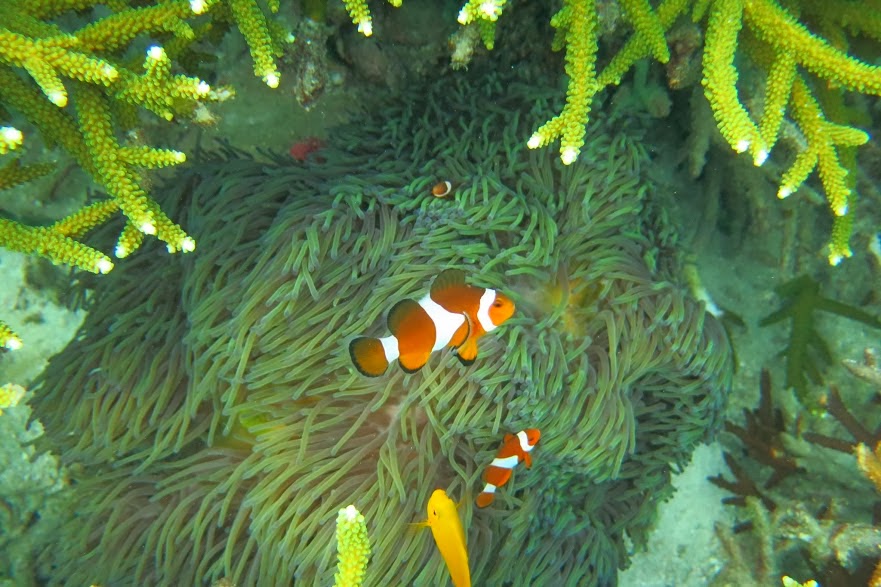
Clownfish at the pristine coral reef site,
Photo by APES classmate Tamara Dibb


Shrimp found in the
fresh water stream
On the second day, as a member of the conservation scientist team, I debated about the pros and cons of setting up Oil Palm plantations on Tioman, much of which is a government protected nature reserve. Later on in the day, we took a belt transect of the rocky shore and random sampling of the percent cover of pedina algae, sea cucumber density, and sponge local frequency. Wading through the water, touching sedentary marine animals was enthralling, especially in such sunny, sticky weather.

Finally, we surveyed the primary and secondary rainforests of Tioman. I didn't know so many shades of green could exist. Under the thick canopy, the refreshing cool air made up for the stiffling humidity and capturing macroinvertebrates in the fresh water stream was rewarding after hiking uphill for several hours. We took soil and leaf litter samples, canopy cover estimates, and tree maturity recordings. 


The stream in the secondary forest,
Photo by APES classmate Tamara Dibb 
I loved bonding with my team as we sorted the shrimp from the fresh water river sample, identified rocks under which scorpions hide at night, using UV light, and eating sunflower seeds on the boat rides. It's so exciting to be able to hug trees that have been standing for over several hundred years. I felt like I was on the set of Jurassic Park. I'm really glad that I have had this opportunity to visit almost untouched tropical rainforest region! I loved it so much. 

A big thank you to my teacher and the TAs for organizing it and helping me rediscover my love for the environment. 

Next up: I'll be writing about my experience at the November 7th to 10th Global Issues Network conference in Beijing. 


Good vibes and prayers going out to the Philippines after the horrific typhoon - more evidence that we need to act on protecting the environment soon. 


Tuesday, October 29, 2013

SAS Solar Launch


On Saturday, SAS hosted the Solar Launch of its 3,356 panel photo-voltaic system! High school and Middle School GIN collaborated with each other for over a month and the result: success. We had Singaporean members of parliament attend, as well as the new American ambassador and our own superintendent at the venue. Elementary school kids dressed up as suns to greet guests, middle school students created videos, held tours all day with high school club members' help, and teachers, staff, parents were present too.  I love events like these because they really gather and demonstrate community support, awareness, and action; and it's one of the reasons I'm using SAS as a case study in my Capstone report. 

Here are some videos featured during the Solar Launch: 


Next week, I'll be going to pristine Tioman Island with my AP Environmental Science class and then Beijing for our annual GIN conference! I've heard that the section of Pulau Tioman we will be staying in is almost untouched by humans and previous years' classes have seen baby sharks; I can't wait to experience living in the real tropical rain forest! I always wonder what Singapore would have looked like 200 years ago and this is my chance to go see it live. The GIN conference is bound to be charged with energy. SAS is taking 20 students, each in a different "Global Action Network Group (GANG)." I'll be a part of the biodiversity and ecosystems group and I hope to be able to take my knowledge from Tioman to Beijing. 


Thursday, October 17, 2013

Climate change strikes again

Pacific islanders are facing difficulties with rising sea levels already. 

BBC just published an article (found here) about a man seeking "climate change asylum" in New Zealand as his home, the Kiribati atolls are severely affected by rising sea levels. Earlier this year, he was denied asylum with the claim that his life was not threatened by conditions in Kiribati. But he's still fighting; decisions will be released in the next couple of weeks. 

While government officials in Kiribati are doing their best to buy land from Fiji and mitigate possible disasters in the near future, it is evident that climate change is causing major problems worldwide, for everyone. 

I imagine that in the next couple of years, cases like these will become a lot more common. What will governments decide to do? Will there be a universal code of acceptance (hopefully not shunning) of those who have lost their homes due to all of our irresponsible actions? 

There have been attempts to raise awareness and persuade the world to empathize with climate change refugees. In 2010, filmmaker Michael Nash produced a documentary named "Climate Refugees," hoping to bring attention to the perilous effects of climate change on people. He asks, in the trailer, "How long is man going to survive on this beautiful planet?" The question goes seamlessly well with what we're discussing in AP Environmental Science right now: the ability of the rapidly changing planet and environment to accommodate more people.


I will be watching this documentary this weekend and I encourage you to as well. I hope to organize a screening of "Climate Refugees" at school soon. 

For me, such incidents really bring out the importance of individual understanding and care. Climate change is a global phenomenon, concerning all 7 billion people; Nash's documentary is what we need to connect with each other. 

Because until the carbon dioxide levels do drop to 350 parts per million, human compassion is all we have to help each other. 


Sunday, September 29, 2013

Climate change is real

You'd think that by 2013, 99.9% of the world would agree that humans have disrupted the balance of the hydrologic, sulfur, nitrogen, phosphorus and carbon cycle. There's too much evidence in our every day lives to ignore it. 

We're not quite there yet. As of Friday, September 27th,  95% of the scientific world agrees that climate change exists. 


On Friday, the Intergovernmental Panel on Climate Change (IPCC) confirmed, with scientific investigations, research, and data to back it up (especially for all the nonbelievers), that "half of the observed increase in global average surface temperatures since the 1950s" is human caused. 

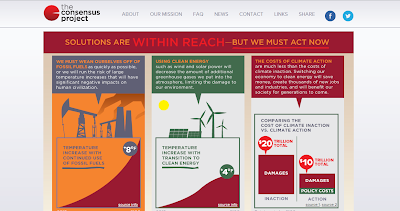
Compare the 95% consensus to the general mindset in 2001; 66% to 95% is a big jump. Several organizations, such as 350.org and The Consensus Project attempt to bring awareness to the masses with simple graphics and campaigns. Their one goal is to educate the public about the degradation of the planet and possible solutions. 

Their reasoning is clear. When the public understands climate change, the causes behind devastating hurricanes and floods stand out. Air pollution and heat waves will be seen as effects of anthropogenic activity. People will begin to realize the impact (financial, environmental, and social) of thermal expansion on ice, glaciers and ice caps melting, and sea levels rising. They'll start reflecting on humanity's actions, think of innovative solutions, and mold the rigid economic systems that restrict much needed actions. 

The 399 parts per million of carbon dioxide in the atmosphere isn't going to disappear over night. Hundreds of factors come into play when making decisions that will mitigate the adverse consequences of climate change. Reaching the truth is definitely one of them. 

Wednesday, September 11, 2013

Environmental updates!

School has begun again! With the homework and tests come exciting environmental initiatives. There are so many ideas and so much energy among the green community - the perfect combination to act! 

Our school installed 3356 solar panels over the summer, with the help of the Solar Energy Research Institute of Singapore (SERIS) and a local solar energy company Sunseap! They account for 30% of the school's energy consumption and can produce 1 MW of power on the sunniest, clearest days. The Middle School Global Issues Network (GIN) club will be working with the High School SAVE and GIN club to present the school's new source of renewable energy to the whole community. It's a great example of direct steps taken by the school to become a greener campus! 

I'm taking a class called Senior Capstone this year. It's an opportunity to independently research and study a subject of my choice. I chose the environment (no surprise!); I'm using Singapore American School (SAS - my school) as a case study, as well as some Canadian schools, and creating a green guidebook for already established schools. My focus is not on the physical campus but the additional efforts a school can take to become a more environmentally friendly community. I'm splitting up initiatives in terms of student driven, technology, and waste management. It's a work in progress but I love being able to connect it to the current AP Environmental Science (APES) class I'm taking. I'm learning of plenty of real life examples to apply my growing understanding of the environment. 

In the past few weeks, I've gone to a couple of talks on biodiversity and plastic. The Singapore Land Transport Authority is planning to build an MRT through the primary forests of Macritchie reservoir. Last Thursday, as a part of a biodiversity talk, botanist Joseph Lai went through 200 slides of pictures (taken by him) of the unique species that live in Singapore's primary forests. He knew all of them by heart and it was incredible to see the variety of life that exists on this once tropical forested island. Visit http://www.chope4nature.org/ to join the protest against the cutting down of this rich primary forest! 

Two weeks ago, I also went to a Plastic Symposium held by the National University of Singapore's SAVE (Students Against the Violation of the Environment) group. They invited several guest speakers - an environmental entrepreneur engaged on the business side of things, a government representative from the National Environment Agency, and an NUS professor who spoke about the impact of plastic on marine life. It was so interesting to see so many different schools there to understand the state of plastic waste in Singapore, despite the fact that it was a Saturday afternoon. I found it especially interesting that plastic, whether recycled or not, is always incinerated in Singapore. 

The year's off to a great start and I'm proud to say I'm a part of it! 


Saturday, July 27, 2013

A few universities' commitment to the environment

UC Berkeley's Road to Zero Waste commitment


Some interesting tidbits from UC Davis' Zero Energy village


The two UCs (University of California) I visited, as you can see, are dedicated to helping the environment and implementing a variety of advertising/awareness techniques that allow everyone to understand their drive to reduce their carbon footprint. 

I also got a chance to talk to some professors at UC Davis and U of Michigan, Ann Arbor. Both are involved in research regarding the efficiency of water purification, and UC Davis has a project that aims to seal up cracks in whole houses using a nitrogen compressor, within one hour. The lab has actually sealed two real houses so far and hope to expand the project to do larger buildings in the future. I think this project is unique in the sense that it offers a very practical solution to energy efficiency - airtight homes mean that less energy can be spent on heating up a home because the warm air is retained. 

A picture of the lab: 

Stanford University's Y2E2 buildings is a tall and strong symbol of the university's commitment to sustainability. New buildings being  constructed are using Y2E2 as the standard, according to our tour guide. It uses 50% of the energy to run and only 10% of the potable water required for fixtures, in comparison to a typical building of its size, according to Stanford News. The energy efficient building is another asset to Stanford's environmentally conscious profile. 

Y2E2

To see more on Y2E2 and picture credit: http://news.stanford.edu/news/2008/march5/y2e2-sustain-030508.html


It's assuring to see so many universities commit to the grueling issues of today's world! Tertiary education is the stage where the somewhat insulated secondary school meets the reality of life and I think the fact that colleges are aiming to bridge the gap is powerful. Students are given the opportunities to glimpse into the solutions that we can implement in the future. 

Think green!


Wednesday, June 26, 2013

Environmental atrophy

Examples of products that waste resources and destroy the planet that I am seeing on a day to day basis here: 


Lawns. Almost all suburban (on a global scale) homes have front and back lawns. These take thousands of gallons of water to maintain, a clear waste of potable water. Even John Green agrees with me! He pictures a world with vegetable gardens instead of yards and imagines the prosperity that would come out of this. 


Krispy Kreme's styrofoam cups! Although you can't tell from the picture, this cup is made of styrofoam. Use paper cups Krispy Kreme! I urge consumers to not drink coffee and/or water if possible at Krispy Kreme - you're supporting sytrofoam cups! 


Tuesday, June 25, 2013

Climate change alerts


Floods are devastating the Indian state of Uttarkhand. This is a clear example of climate change. Unstable grounds, mass tourism, and torrential rains during the monsoon season are highlighted as the primary reasons for such a natural disaster. 

I keep thinking back on my time as a facilitator at the GIN conference for the Natural Disaster Prevention and Mitigation team when I read news reports claiming that the Indian government did not warn the local people about the possibility of floods. 

While June to September is usually the monsoon season in India, the heavy rain coupled with frequent landslides has culminated in losses of life and disaster. 

Prayers going out to Uttarkhand. 


The ultimate conclusion: We need to fight climate change.

Thursday, June 20, 2013

Psi 400

A short post about Singapore's alarming pollution levels today.

The pollution standard index in Singapore has just reached 400, out of a maximum of 500. Over 300 is considered hazardous.

Taking a brief walk down the road is scary.

In California, on days when smog levels are above the EPA's federal healthy maximum, a program called Spare the Air is implemented. Air pollution activities are reduced to reduce the levels of pollution outdoors.

Such a program would be beneficial for Singapore at a time when the reading is above 400!

Hope everyone in Singapore is safe and healthy.

Tuesday, June 18, 2013

Green on the go - SFO Airport

As I travel around the US visiting colleges that I'll be applying to in the fall, I'll chronicle some of interesting environmental findings I come across - starting off with California. 

1. San Francisco, CA - airport

Ranked #1 by the Siemens Green City Index for its remarkable management of waste, carbon dioxide emissions, air and water quality, transport, land use, and building intelligence, San Francisco is well known for its policies enforcing sustainability. It's airport demonstrates the city's  environmentally focused programs. Terminal 2's bathrooms, Gold LEED certified, proudly inform visitors about the energy they are saving. 

The airport restrooms feature automatic faucets, toilets and Dyson airblade dryers! 


Wednesday, May 15, 2013

399 > 350 ppm Carbon Dioxide


Just a few weeks after Earth Month, you might expect positive results from all the environmental efforts being done worldwide.

The opposite, however, has been reported from scientists of the Scripps Institution of Oceonography, from Mauna Loa volcano in Hawaii. 


We are currently at 399 parts per million of carbon dioxide worldwide. 

400 ppm of carbon dioxide is an unprecedented measure of carbon dioxide and is a key indicator of the needed involvement of politicians as well as common citizens to help the situation. Carbon dioxide levels are rising exponentially and contributing significantly to global warming, as the gas amplifies the greenhouse gas effect. 

Fossil fuels can be identified as the top contributor to rising carbon dioxide levels and the group 350.org has been active for the past several years to influence policy makers to start acting on the issue. 350 parts per million of carbon dioxide is the appropriate healthy level for the world. 

Read more about 350.org on my blog here, or visit their website. Get involved; the near future calls for it. The governments of the world and society at large can't hold off such an issue much longer. 

Here's a graphic from the New York Times that puts everything into shocking perspective: 


In the wake of global carbon dioxide levels reaching 400 ppm, Global Issues Network at SAS is holding a 350.org movie event called Do The Math. Check to see if there are any viewings in your area: http://act.350.org/event/do_the_math_film/search/.


350 ppm - Do The Math! Let's do our part to help the environment. 

To learn more about rising carbon dioxide levels, visit http://rendezvous.blogs.nytimes.com/2013/05/06/with-carbon-dioxide-approaching-a-new-high-scientists-sound-the-alarm/ and http://350.org/